
SUPPORT
Dementia Clock: What It Is and Why Families Are Choosing Memoryboard
A dementia clock can help someone with memory loss understand the time, date, and part of the day. But many families need more than a clock. They need a simple way to share reminders, routines, and loving messages throughout the day.
From repeated questions to missed meals, appointments, medication reminders, and daily confusion, families are looking for tools that make the day feel easier, calmer, and more familiar.

Written by
Tyler Zanini, Founder at Memoryboard

What Is a Dementia Clock?
A dementia clock is a clock designed to help people with dementia, Alzheimer's, or memory loss better understand the time and date.
A regular clock only shows the hour. A dementia clock gives more context. Many dementia clocks show the day of the week, full date, time of day, and sometimes simple reminders.
For someone with memory loss, this extra information can make a big difference. It can help answer questions like:
What day is it?
Is it morning or night?
Did I already eat?
Do I have an appointment today?
Is someone coming to visit?
When will my family call?
The goal of a dementia clock is simple. It gives the person a clear place to look when the day feels confusing.
Why Time Can Feel Confusing with Dementia
Dementia can affect memory, attention, and the ability to process daily information. This can make time feel unclear, even in a familiar home.
A loved one may ask the same question several times in one day. They may forget what they just did, what is coming next, or whether someone already explained the plan.
This is not usually because they are trying to be difficult. It is often because their brain is not holding onto the information in the same way anymore.
Common signs that time is becoming confusing:
Asking the date or time often
Confusing morning and evening
Forgetting meals or appointments
Becoming anxious about upcoming plans
Calling family repeatedly for reassurance
Feeling unsure about who is coming or when
A visual reminder can help reduce some of that uncertainty. It gives your loved one something steady to return to throughout the day.
How a Dementia Clock Helps Families
A dementia clock can help create structure in the home. It gives your loved one simple information without requiring them to use a phone, app, or complicated device.
Common benefits include:
1.
Fewer repeated questions — A clear clock can answer basic questions about the day, date, and time.
2.
More independence — Your loved one can check the clock on their own instead of always needing to ask someone.
3.
A calmer daily routine — Seeing the part of the day can make mornings, meals, appointments, and bedtime easier to follow.
4.
Better reassurance — A clear visual display can help someone feel more grounded when they are confused.
5.
Less stress for caregivers — Families and caregivers may feel more supported when important information is visible.
For many families, a dementia clock becomes part of the daily routine. It helps the home feel more organized and predictable.
Where a Dementia Clock Falls Short
A dementia clock is helpful, but it usually only answers one type of question. It tells someone the time, date, or part of the day.
But families often need to communicate more than that.
They may need to remind their loved one:
What is happening today
Who is visiting
What is for lunch or dinner
When a caregiver will arrive
Whether medication was already taken
That family will call later
That they are safe and loved
This is where a simple clock may not be enough.
A person with dementia may not only need to know that it is Tuesday at 10:00 AM. They may need to know, "Your daughter is coming at 2:00 PM," or "Lunch is in the fridge," or "You do not have any appointments today."
That extra context can help make the day feel less confusing.
Why Pick Memoryboard Instead of a Basic Dementia Clock?
Memoryboard gives families the benefits of a dementia clock, while also allowing them to share clear reminders and personal messages.
Instead of only showing the time and date, Memoryboard can display the information your loved one needs most during the day.
Memoryboard can help show:
Today's date
Daily reminders
Meal reminders
Appointment updates
Family messages
Caregiver arrival times
Reassuring notes
Simple routines
This makes Memoryboard more flexible than a standard dementia clock. Families can use it to support memory, routine, and connection.
Example messages families can share on Memoryboard:
"Good morning, Mom. Today is Monday."
"Lunch is in the fridge."
"Your caregiver will arrive at 10:00 AM."
"You have no appointments today."
"I will call you after work."
"Dinner is at 6:00 PM."
"Please drink some water."
"You are home and safe."
"We love you."
These small messages can make a big difference. They help answer questions before they become stressful.
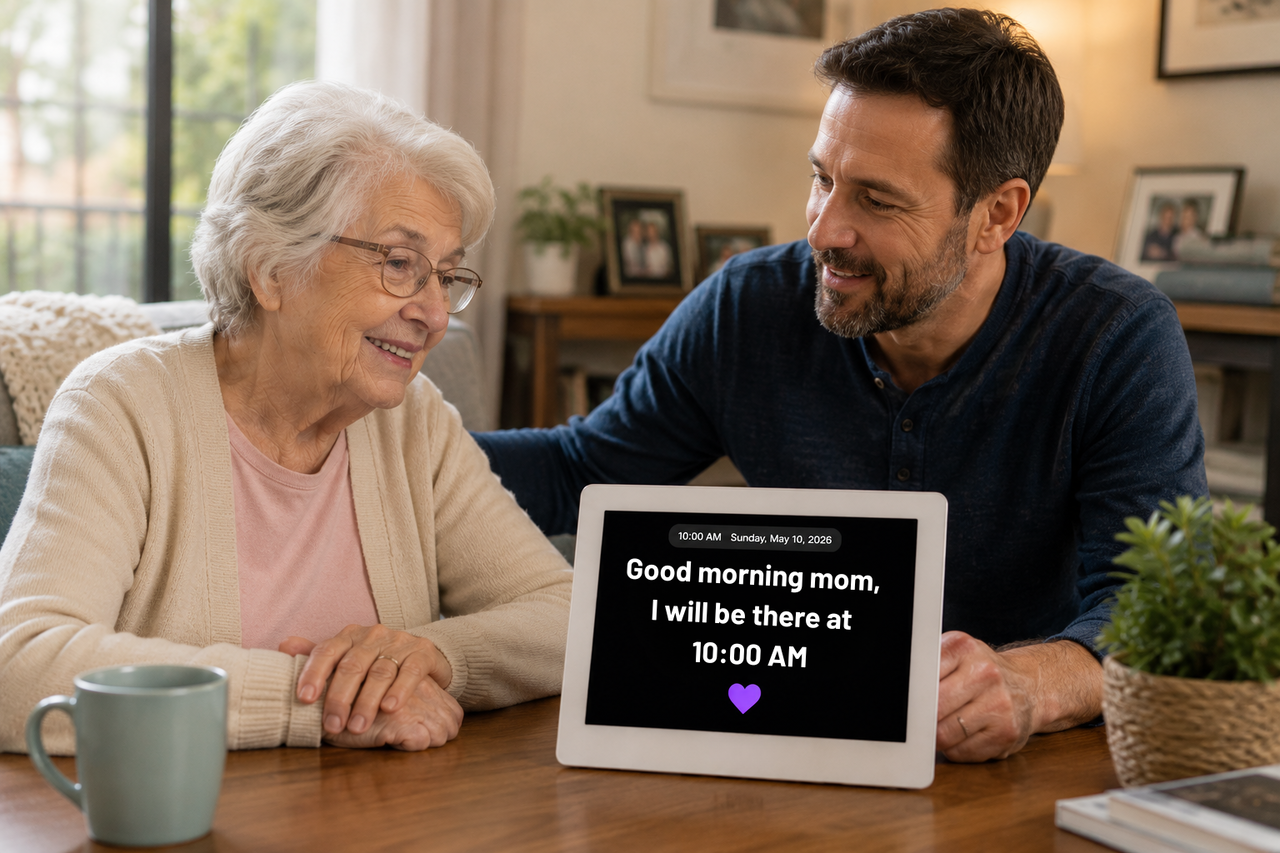
Memoryboard displaying a simple daily reminder for an older adult with memory loss.
Dementia Clock vs. Memoryboard
A simple comparison to help you see the difference.
Feature
Basic Dementia Clock
MemoryBoard
Shows time
Yes
Yes
Shows date
Yes
Yes
Shows part of day
Often
Yes
Custom family messages
Limited or no
Yes
Meal reminders
Sometimes
Yes
Caregiver updates
Usually no
Yes
Emotional reassurance
Limited
Yes
Easy for family to update
Depends
Yes
Feels personal
Limited
Yes
A dementia clock can be a helpful starting point. But Memoryboard gives families a more personal way to support daily life. It helps your loved one see what matters most, not only what time it is.
Who Can Benefit from a Dementia Clock or Memoryboard?
A dementia clock or visual reminder board may help if your loved one is starting to struggle with time, routine, or daily reminders.
It may be useful for:
Older adults living at home
People with early-stage dementia
People with Alzheimer's
Seniors who ask repeated questions
Families supporting a parent from a distance
Spouses who need help reinforcing daily routines
Assisted living residents who need visible reminders
Caregivers who want fewer repeated conversations
The best time to introduce a tool like Memoryboard is often before daily confusion becomes overwhelming. This gives your loved one time to get used to seeing reminders in one familiar place.
What to Look For in a Dementia Reminder Tool
Whether you choose a dementia clock or Memoryboard, the tool should be simple. Too much information can feel overwhelming.
Look for:
Large, easy-to-read text
Simple wording
Clear contrast
A clean screen
Custom reminders
Easy updates for family members
A design that feels calm
A setup that does not require the older adult to manage technology
The best tool is the one your loved one will actually look at and understand.
How Families Use Memoryboard Every Day
Families can use Memoryboard in many simple ways. The goal is to make important information visible before confusion starts.
Use Memoryboard for:
1.
Morning reminders
Example: Good morning, Dad. Today is Wednesday. Breakfast is ready.
2.
Meal support
Example: Lunch is in the fridge. Please warm it for 1 minute.
3.
Appointment reminders
Example: Your doctor appointment is today at 2:00 PM. Sarah will pick you up.
4.
Family connection
Example: I will call you after work. I love you.
5.
Caregiver updates
Example: Maria will arrive at 9:30 AM today.
6.
Reassurance
Example: You are safe at home. Everything is okay.
The messages do not need to be complicated. Short, clear messages usually work best.
A Simple Way to Bring More Calm Into the Day
Dementia can make everyday routines feel uncertain. Families often repeat the same reminders again and again because they want their loved one to feel safe and supported.
A dementia clock can help with time and date confusion. Memoryboard can help with time, reminders, routines, and connection.
For many families, that is the difference.
Memoryboard helps put the most important information in one visible place. It gives your loved one clear guidance. It gives your family an easier way to stay connected. And it can make the day feel a little more familiar.
Help Your Loved One Live with Confidence
Dementia clocks are a game-changing solution for supporting people with memory loss and their caregivers. The right clock empowers daily routines, reduces anxiety, and gives families invaluable peace of mind.
Prioritize ease of use, display clarity, and helpful features like automated settings and reminders.
Choose the Right Size for Your Space
Pick the 10.1″ for nightstands and kitchen counters.
Pick the 15.6″ for living rooms and reading across the room.
Shop Memoryboard


