
Family Caregiving · 12 min read
The Sandwich Generation: Caring for Aging Parents While Supporting Your Own Family
Practical, judgment-free guidance for adults balancing caregiving for aging parents with raising their own family.

What Is the Sandwich Generation?
The "sandwich generation" refers to adults — often between the ages of 40 and 65 — who are raising their own children while also caring for aging parents. They're "sandwiched" between two generations who both need their time, attention, and support, often at the very same moment.
This is an increasingly common experience. As people live longer and families spread across different cities, more adults find themselves managing school drop-offs and doctor's appointments in the same busy week. If this sounds like your life, you're far from alone — and there's no single "right" way to do it.
Sandwich generation caregivers wear many hats. Caring for aging parents while keeping a household running takes real coordination, patience, and support — which is exactly why small tools that reduce daily confusion can make such a big difference.
Common Responsibilities Sandwich-Generation Caregivers Manage
Managing parents' medical appointments and medications
Helping with household tasks and finances for aging parents
Driving kids to school, activities, and appointments
Keeping up with work responsibilities and deadlines
Coordinating family schedules and communication
Finding time for meals, errands, and everyday household management
Signs of Caregiver Stress and Overload
Sandwich-generation caregivers often push through exhaustion without pausing to notice the warning signs. When you're juggling aging parents, growing kids, and everything in between, it's easy to keep going until you're running on empty. It's completely okay to acknowledge caregiver stress — recognizing it isn't a weakness, it's a sign that you're paying attention to your own wellbeing, too.
Constant fatigue
Feeling tired even after a full night's rest, with energy that never quite comes back no matter how much you sleep.
Irritability or guilt
Snapping at the people you love over small things, then feeling a wave of guilt for losing your patience.
Falling behind
Missing appointments or forgetting tasks for work and family, as the mental load piles up faster than you can keep track.
Losing time for yourself
No space left for hobbies, friends, or simple rest — the things that used to recharge you keep slipping off the calendar.
Recognizing these signs is the first step toward finding support — for your parents and for yourself.
Sharing the Load: Dividing Responsibilities With Siblings and Family
Caring for a loved one with memory loss was never meant to rest on one person's shoulders alone. When the responsibility falls entirely to a single family member, exhaustion and resentment can quietly build — even in the closest of families. Opening up honest, non-judgmental conversations with your siblings and relatives can lighten the weight for everyone. Reaching out for family caregiver support isn't a sign of failure; it's a way of making sure your loved one is cared for and that no one is carrying more than they can hold.
Practical Ways to Divide Responsibilities
Hold a family meeting to list every caregiving task and openly discuss who can take each one.
Assign roles based on individual strengths — one sibling handles finances, another manages medical appointments, and another leads emotional check-ins.
Use a shared family calendar so everyone can see upcoming appointments, visits, and responsibilities at a glance.
Rotate responsibilities during holidays or especially busy seasons so no one is stretched too thin.
Check in with each other regularly to make sure one person isn't quietly becoming overwhelmed.

Siblings coordinating caregiving responsibilities together over coffee.
How Routines, Calendars, and Visual Reminders Can Support Aging Parents
Predictable routines and simple visual cues can make an enormous difference in how confident and independent an aging parent feels each day. Large-print calendars, written reminders posted where they're easy to spot, and photos of familiar family members all help the day feel steady and clear. Thoughtful daily reminders for seniors — a note about lunch, a gentle prompt about an afternoon walk, a photo of the grandkids — reduce everyday uncertainty and, in turn, can ease the number of check-in calls caregivers feel they need to make. It's not about doing everything for them; it's about building small, comforting anchors into the day.
Consistent daily rhythms
The same routine for meals, medication reminders, and rest helps reduce confusion.
Visual, easy-to-read reminders
Large text and simple visuals are easier to follow than small notes or apps.
Familiar faces nearby
Photos of family members create comfort and connection throughout the day.
How Technology Can Help Families Stay Connected From a Distance
Many in the sandwich generation are supporting aging parents from a distance — juggling their own kids, careers, and a household that may be hours away from Mom or Dad. When you can't be there in person, simple technology for aging parents can quietly bridge that distance and keep everyone feeling close. The key is choosing caregiver communication tools that are genuinely simple for older adults to use — no complicated apps to download, no logins to remember, and no squinting at small screens. The right tool should fade into the background of daily life and simply work.
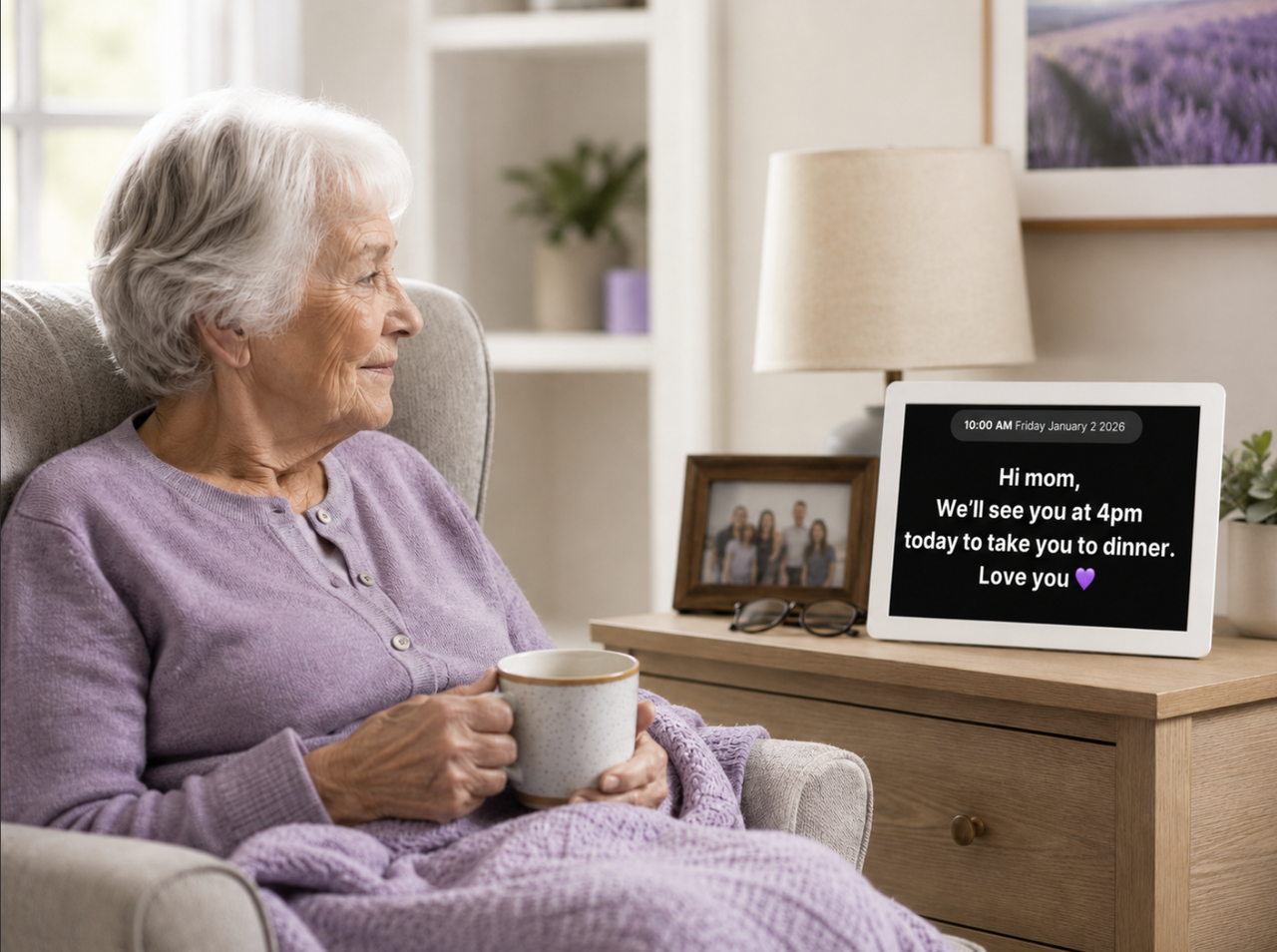
A simple connected display keeps an aging parent in touch with family, no complicated apps required.
What Doesn't Always Work
Small phone screens that are hard to read
Multiple apps and passwords to manage
Texts that get missed or ignored
What Helps
One shared, always-on display
Large, simple visuals anyone can read
Updates that appear automatically for everyone in the family
How Memoryboard Can Support Daily Routines
Memoryboard is a simple connected display that lets everyone in the family remotely share reminders, appointments, photos, and messages with an aging parent — all appearing automatically on one clear screen they can see at home. There's nothing for them to set up and no buttons to press; the updates you send from your phone simply show up on their board throughout the day. And because Memoryboard has no monthly subscription, staying close doesn't add another recurring bill to the mix.
Daily reminders
Medication times, meals, and simple to-dos appear automatically.
Appointments
Family members add doctor visits or events from anywhere.
Photos
Grandkids' school photos and family moments show up automatically.
Family messages
Quick notes and check-ins from anyone in the family — no app or login needed for the parent.
Choose the Memoryboard That Fits Your Home
Two clear, easy-to-read screens — pick the size that feels right for your loved one's space.
Protecting Your Own Time, Health, and Relationships
Caring for yourself isn't selfish — it's part of being able to keep showing up. When you protect your own time, health, and relationships, you build the steady foundation that makes family caregiver support sustainable for the long run. Looking after aging parents and your own family is a marathon, not a sprint, and the small ways you refill your own cup are what let you keep giving with patience and love.
Schedule short breaks and protect them like appointments — a walk, a coffee, or a quiet half hour is time you're allowed to keep.
Ask for help before you're overwhelmed, not after — reaching out early keeps small strains from becoming heavy ones.
Stay connected with friends and your own family for emotional support — the relationships that sustain you deserve tending too.
Set small boundaries around your time and energy — saying no to one thing is often what makes room for what matters most.
Celebrate small wins instead of focusing only on what's left to do — a good day, a shared laugh, a calm evening all count.
Frequently Asked Questions
The sandwich generation describes adults, often between ages 40 and 65, who are raising their own children while also caring for aging parents. They are 'sandwiched' between the needs of two generations at once.
Common signs include constant fatigue, irritability, forgetfulness, and feeling like there's never enough time for yourself. If caregiving feels overwhelming, it may help to talk with family or a trusted professional for support.
Start with an honest, low-pressure conversation. List out what needs to be done, then talk through who can realistically take on each task based on schedules, location, and strengths.
Simple tools like shared calendars, phone check-ins, and connected displays like Memoryboard can help you stay involved in daily life and share reminders, photos, and messages even from a distance.
No. Memoryboard is a connected display that lets family members share reminders, appointments, photos, and messages — with no monthly subscription required.


