
Caregiver Resources
Dementia Reminder Boards: A Simple Way to Support Daily Routines
Every caregiver knows the questions that come again and again:
“What day is it?”
“What time is my appointment?”
“Is someone coming to visit?”
“What am I supposed to do next?”
Dementia reminder boards give older adults one clear place to see important information throughout the day — the date, time, upcoming plans, and gentle prompts from family. When the answers are always visible, families can spend less time repeating themselves and more time simply connecting.

A practical guide for families and caregivers.
What Is a Dementia Reminder Board?
A traditional whiteboard is a familiar starting point for many families. It keeps notes and reminders in one visible spot, but everything has to be written and rewritten by hand. When plans change, someone has to be there in person to update it — and the date and time never keep themselves current.
A paper calendar offers a clear view of the week or month ahead, which can be reassuring. Still, it only shows what was written down in advance. It can't gently prompt a medication time, reflect a last-minute appointment, or let a family member add a note from across town.
A dementia clock makes the day, date, and time easy to read at a glance, which helps ease common questions and confusion. Its focus, however, is time orientation — it isn't built to hold appointments, routines, photos, or personal messages. You can read more in our guide to dementia clocks.
A digital reminder board for seniors brings these ideas together. It stays always visible like a whiteboard, keeps the day and time updated automatically, and lets caregivers and family add appointments, reminders, and messages remotely from a phone — something paper calendars and simple dementia clocks can't offer. The result is one calm, up-to-date screen that supports independence at home.
A reminder board can display information such as:
Day, date, and time
Appointments
Medication reminders
Meals
Daily routines
Family visits
Transportation
Photos
Personal messages
Why Visual Reminders Can Help Someone With Dementia
Memory challenges can make an ordinary day feel uncertain. Visual reminders for dementia put helpful information where it can be seen at a glance, which often supports three things that matter most at home: orientation, routine, and communication.
Orientation comes from clearly seeing the day, date, time, and what's happening next. When this is always visible, a loved one can reassure themselves without needing to remember it all — easing the quiet worry of not knowing where they are in the day.
Routine brings a predictable rhythm to the day. Seeing meals, medication times, and activities in the same familiar place helps the day feel calm and steady, which can lower confusion and anxiety.
Communication keeps a loved one feeling connected to family — seeing photos, messages, and upcoming visits without having to ask. That sense of connection can be as comforting as any single reminder.
A gentle note: reminder boards do not treat, cure, prevent, or slow dementia. They are supportive tools for daily life and communication — not medical treatment. Always follow guidance from your loved one's healthcare provider.
Benefits of Dementia Reminder Boards
Helps With Time and Date Orientation
Seeing the day, date, and time in one clear place helps someone stay oriented throughout the day. Visual reminders for dementia can gently answer "what day is it?" before the question even comes up. This steady sense of time often brings real comfort.
Supports a Consistent Daily Routine
A predictable rhythm to the day can feel reassuring when memory is uncertain. A reminder board keeps meals, medication times, and activities visible in the same spot each day. That consistency helps the day feel calmer and more manageable.
May Reduce Repeated Questions
When answers are always visible, there's less need to ask again and again. A clear board can help reduce repeated questions about the date, upcoming plans, or who is visiting. This eases stress for your loved one and for you.
Helps Long-Distance Caregivers Stay Involved
Family who live far away can still take part in daily life. Using a simple app, they can add reminders, appointments, and notes from anywhere. It's a caring way to stay connected without needing to be in the room.
Keeps Family Photos and Messages Visible
Familiar faces and warm words can brighten an ordinary day. A board can display tagged family photos and personal messages that stay in view. Feeling connected to family — without having to ask — can be deeply reassuring.
Makes Important Information Easier to Find
Key details don't have to be searched for or remembered. A reminder board keeps appointments, routines, and important notes in one easy-to-read place. Having everything in a single spot makes daily life simpler for everyone.
What to Look for in a Dementia Reminder Board
Not all reminder boards are created equal. Whether you're comparing options for a loved one or setting one up for the first time, these are the practical features that make a real difference in everyday use.
Large, readable text — big, high-contrast numbers and words that can be seen clearly from across the room.
Clear, uncluttered layout — a clean screen that shows what matters most without overwhelming detail.
Simple, calm messages — gentle, reassuring wording that supports rather than confuses.
Remote access for caregivers — the ability to add reminders and messages from a phone, anywhere.
Automatic date and time updates — the day, date, and time stay accurate on their own, with no adjusting needed.
Scheduling options for future reminders — set appointments and routines ahead of time so nothing is missed.
Space for photos and personal messages — room to share familiar faces and warm notes from family.
Minimal buttons or complicated controls — nothing for your loved one to press, manage, or accidentally change.
A reliable Wi-Fi connection — steady updates depend on a stable connection to stay current and dependable.
Easy setup for the whole family — a straightforward first-time setup that works right out of the box.
Digital Dementia Reminder Boards vs. Traditional Whiteboards
A whiteboard can be a helpful start, but families often find its limits quickly. Here's a practical, side-by-side look at how a digital reminder board compares in everyday use.
Feature
Traditional Whiteboard
Digital Reminder Board
Remote updates
Manual only
Update from your phone
Scheduled messages
Not possible
Set reminders in advance
Automatic date and time
Written by hand
Always accurate on its own
Photos
Not supported
Share family photos
Ease of use
Needs constant rewriting
Nothing for them to press
Flexibility
Fixed once written
Change anything, anytime
Caregiver involvement
In person only
Stay connected from anywhere
Where Should You Place a Dementia Reminder Board?
The right spot makes all the difference. A reminder board works best when it lives somewhere your loved one naturally looks throughout the day. Here are the places families find work well most often.
Kitchen table
Living room
Near a favorite chair
Bedroom doorway
Assisted living apartment
Near a medication area
A few practical tips make placement even more effective. Choose a spot with good, even lighting so the screen stays easy to read at any time of day, and avoid placing it opposite a window where glare can wash out the display. Keep it at eye level and within clear line of sight from where your loved one spends the most time. Most importantly, pick a place they already look at regularly — such as near where they eat, watch television, or settle in each morning — so glancing at the board becomes a natural part of their daily routine rather than something they have to remember to do.
How to Write Effective Dementia Reminders
The words you choose matter more than you might expect. The most helpful reminders are short, calm, specific, and respectful — written to gently guide rather than to instruct or correct. Keep each message to a single clear idea, use plain language, and always speak to your loved one the way you would in person: warmly and with care.
Good examples
“Today is Monday, July 13.”
“Anna will visit at 3:00 p.m.”
“Your ride arrives at 9:30 a.m.”
“Lunch is at 12:00 p.m.”
“Please bring your blue sweater.”
“You are home and everything is okay.”
Notice what these examples have in common. They avoid vague language like “later” or “soon,” speak directly using first person or clear direct address, and are reassuring rather than alarming. A well-written reminder never scolds or pressures — it simply offers a calm, steady point of orientation that helps your loved one feel confident and at ease throughout their day.
Sample Daily Schedule for a Dementia Reminder Board
A gentle, predictable rhythm brings comfort. Here is an example of how a full day might look on the board — calm, clear reminders that guide your loved one from morning to bedtime, one reassuring step at a time.
7:30 a.m.
Good morning! Time to get up and get dressed.
8:00 a.m.
Breakfast is ready in the kitchen.
9:30 a.m.
Your ride arrives for your doctor's appointment.
12:00 p.m.
Lunch is at 12:00 p.m.
2:00 p.m.
Anna will visit at 3:00 p.m. — get ready!
3:00 p.m.
Anna is here to visit.
5:30 p.m.
Dinner is ready.
7:00 p.m.
Time to relax and watch TV.
9:00 p.m.
Time to get ready for bed. You are home and everything is okay.
How Memoryboard Supports Seniors and Caregivers
Memoryboard is a digital reminder board created for seniors, people experiencing memory loss, and the families who care for them. It brings a calm, familiar rhythm to each day — showing gentle reminders, personal messages, and a clear view of the time, so loved ones feel oriented, reassured, and connected.
Caregivers can send reminders remotely, right from their own phone.
Families can share photos and personal messages to brighten the day.
Appointments and daily routines can be scheduled ahead of time.
The recipient does not need to use a phone, tablet, or complicated app.
The display is simple and easy to read, with large text and a clear layout.
A full-screen clock shows the day, date, time, and time of day when no other message is showing.
Families can stay connected while traveling or living far away.
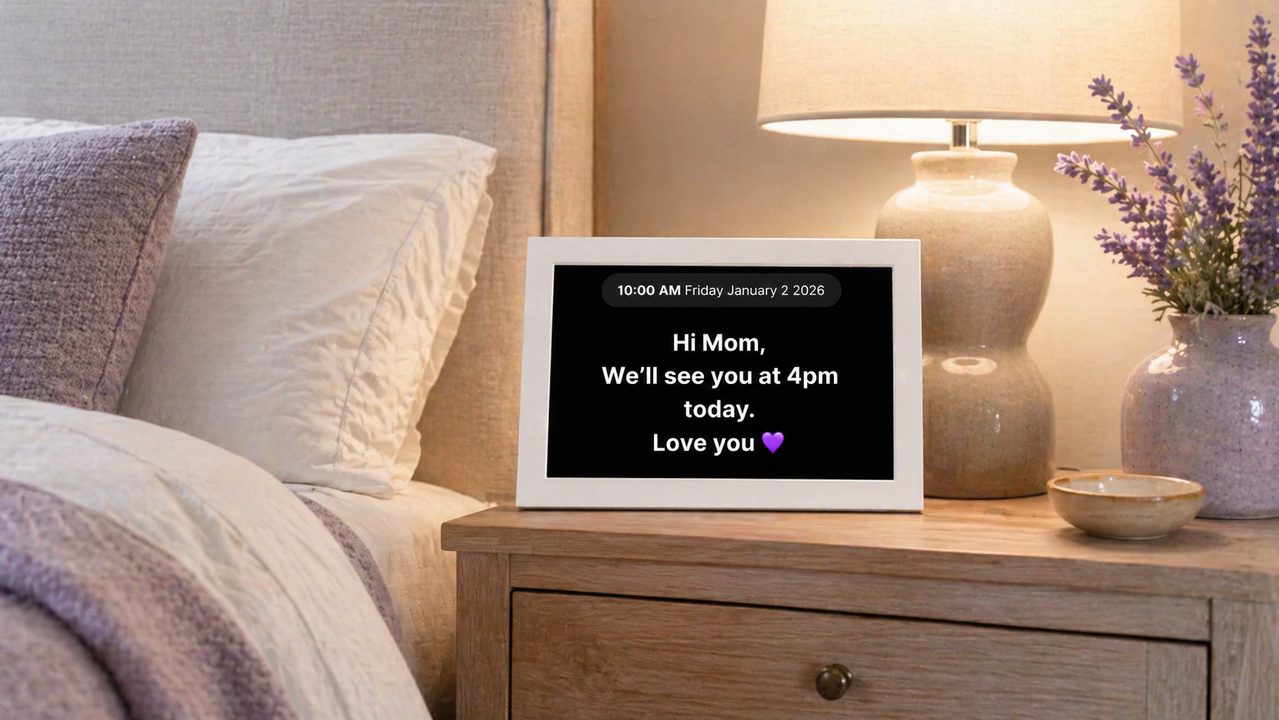
Every family's needs are a little different. Take a moment to explore Memoryboard and see if it feels like the right fit for your loved one and your family.


