
Caregiving & Memory Support
For the Caregiver Who Became the Reminder
The quiet, repeated job inside caregiving that no one talks about — and a calmer way to carry it.
By the Memoryboard Team · Caregiving Guide

The Caregiver Job No One Sees
You check the time. Your mom has an appointment at noon. You already reminded her once this morning. You know you may need to call again before she leaves. You want to help. But you do not want every conversation to feel like a correction.
This is the quiet, repeated part of caregiving. The part that does not always have a name. The part that happens before the appointment, before the day begins, and after everything else is done. The part that lives in your head even when you are not in the room.
If you have ever been the person who remembers so someone else does not have to — you already know what this feels like.
Caregiving is one of the most important jobs in the world. A lot of it is invisible.
When Love Starts to Sound Like a Reminder
Somewhere along the way, something shifts. You become the person who holds the schedule. The one who knows what day it is, what time the appointment is, whether the medication was taken, and whether lunch happened.
You are not just a daughter, son, or spouse anymore. You are also the calendar. The alarm clock. The backup plan. The person who calls to check in — and then calls again just to be sure.
Sound familiar?
Don't forget your appointment.
Remember to eat lunch.
Take your medicine.
Your daughter is visiting at 2.
Today is Wednesday.
The aide is coming this afternoon.
These are the words that caregivers say every day. They come from love. But after a while, they can start to feel like a weight — for the person saying them, and sometimes for the person hearing them too.
Why Reminders Can Start to Feel Hard
Here is the thing no one says out loud: reminders can start to feel hard for everyone involved.
For the caregiver
You want to help. You do not want to nag. You repeat yourself and feel guilty for feeling tired of it. You worry that if you stop reminding, something important will be missed.
For the loved one
They want to feel independent. Being reminded can feel like being corrected. It can feel like a loss of control. They may not say it, but the reminder itself sometimes stings.
This tension is real. It does not mean you are doing it wrong. It means you are carrying something heavy — and you deserve support that makes it lighter.
Why Sticky Notes Are Not Always Enough
Most caregivers have already tried everything they can think of. You are creative. You are resourceful. You have probably tried more than one of these:
Sticky notes
Printed calendars
Whiteboards
Phone alarms
Texts & calls
Daily checklists
Why they sometimes fall short:
The note may be missed or ignored.
The phone may not be answered.
The text may not be opened.
The whiteboard may not get updated.
The caregiver still carries the mental load.
None of this is a failure. These tools were the best available at the time. But caregiving deserves better tools — ones that reduce the mental load, not just shift it.
A Calmer Way to Help Someone Remember
People with memory loss often do best with simple, visible cues in a familiar place. Not a phone call at the right moment — but a message already there, waiting calmly, when they look up.
When information lives in the room — when the reminder is part of the environment rather than an interruption — something shifts. The person feels more settled. The caregiver feels less responsible for every single moment.
Sometimes the best reminder is not another call. Sometimes it is a calm message already waiting — where your loved one can see it.
That is the idea behind Memoryboard.
How Memoryboard Supports Daily Routine
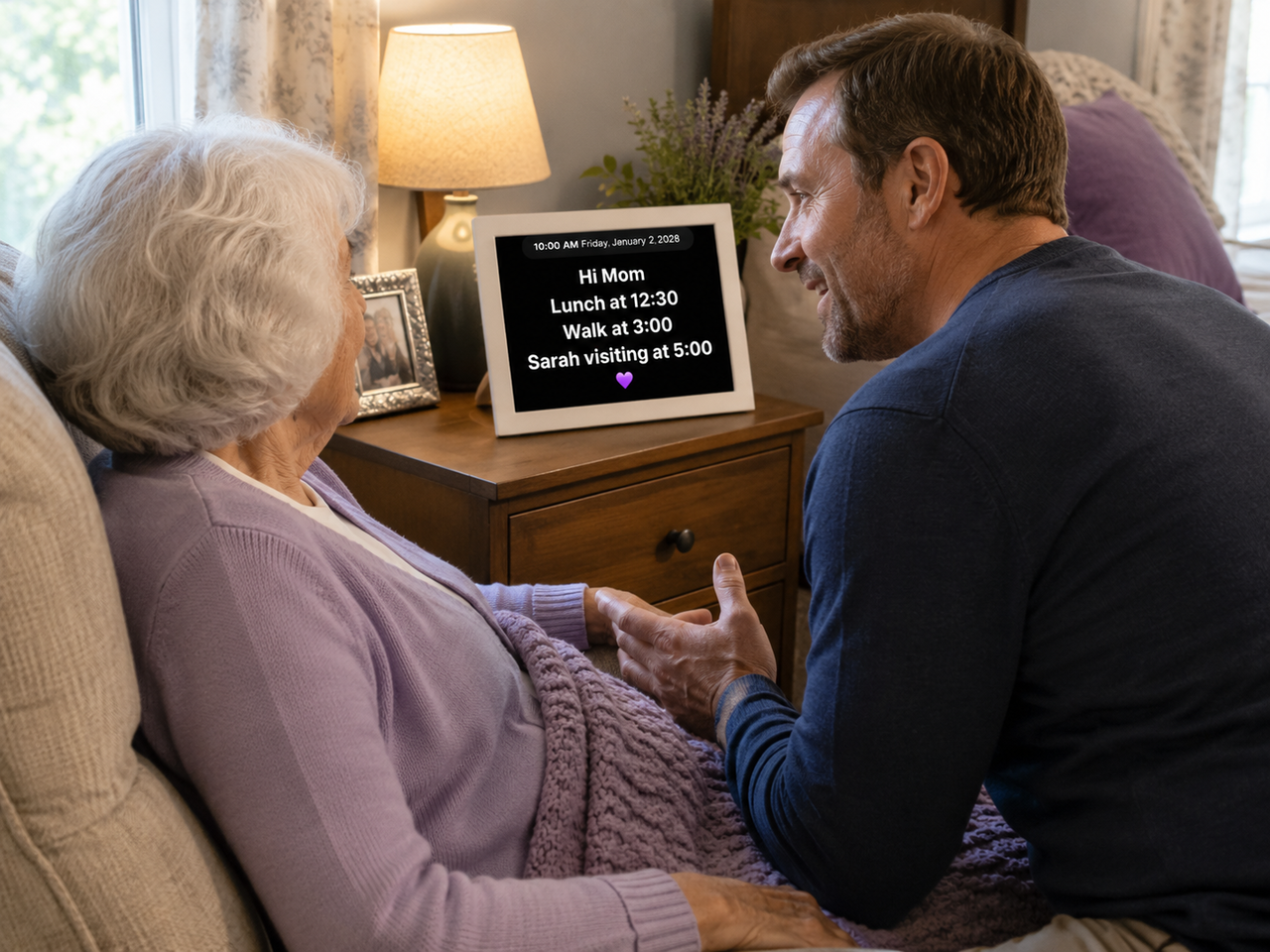
Memoryboard is a simple digital display designed for people with memory loss and the families who support them. It shows reminders, photos, messages, and daily schedules in one calm, visible place — already in the room, already updated, no interaction required from your loved one.
What makes it different
A calm digital display that lives in the room
Family members can send updates from anywhere
No app for your loved one to open or learn
Reminders are always visible — no button to press
Designed to support independence and dignity
You do not have to change how your loved one uses technology. Memoryboard works for them — so you can do a little less worrying.
Real Ways Families Use Memoryboard
Every family is different. But here are some of the ways families use Memoryboard to make daily life a little calmer:
Appointment Reminders
Show today's appointments so nothing is missed or forgotten.
Meal Reminders
A gentle nudge at breakfast, lunch, or dinner time.
Medication Prompts
A calm visible reminder when it is time to take medication.
Who Is Coming Over
Let your loved one know who to expect — and when.
Daily Schedule
A simple view of the day's plan, already in the room.
Photos From Family
Send photos from children or grandchildren to brighten their day.
Good Morning Messages
Simple messages like 'Good morning, Mom. We love you.'
Home & Routine Cues
Familiar anchors that help with orientation and daily rhythm.
Family Visits
Remind your loved one about upcoming visits — before they ask.
What Families Tell Us
We hear from families every week. Here is what some of them have shared:
“
Memoryboard helped us cut down on reminder calls. My mom sees her schedule before I even have a chance to call.
Sandra T. · Daughter & Caregiver
“
It gave my dad more confidence during the day. He knows what is coming and does not feel caught off guard.
James R. · Son & Caregiver
“
I used to spend so much time making printed lists. Now I update everything from my phone in seconds.
Maria L. · Spouse Caregiver
“
Even when we cannot be there, Memoryboard helps us stay connected. Sending a photo or a message means so much to her.
The Chen Family · Long-distance Caregivers
Names have been changed or are composites shared by our community.
For the Caregiver Who Became the Reminder
Memoryboard was not built to replace the love and attention you already give. It was built to make the caregiving you are already doing feel a little lighter, a little calmer, and a little more human.
You should not have to carry the whole day in your head. Your loved one deserves a calm, clear day — and so do you.
If you have become the reminder for someone you love, Memoryboard was built for you.
Memoryboard · Caregiver Support · Memory Care Families
Make the Day Easier to Follow
Memoryboard helps families create a calm, visible routine at home — with reminders, appointments, photos, and messages in one familiar place.
Designed for older adults and people living with memory loss. Simple for caregivers to set up and update.
Choose the Right Size for Your Space
Pick the 10.1″ for nightstands and kitchen counters.
Pick the 15.6″ for living rooms and reading across the room.
Explore Memoryboard


